
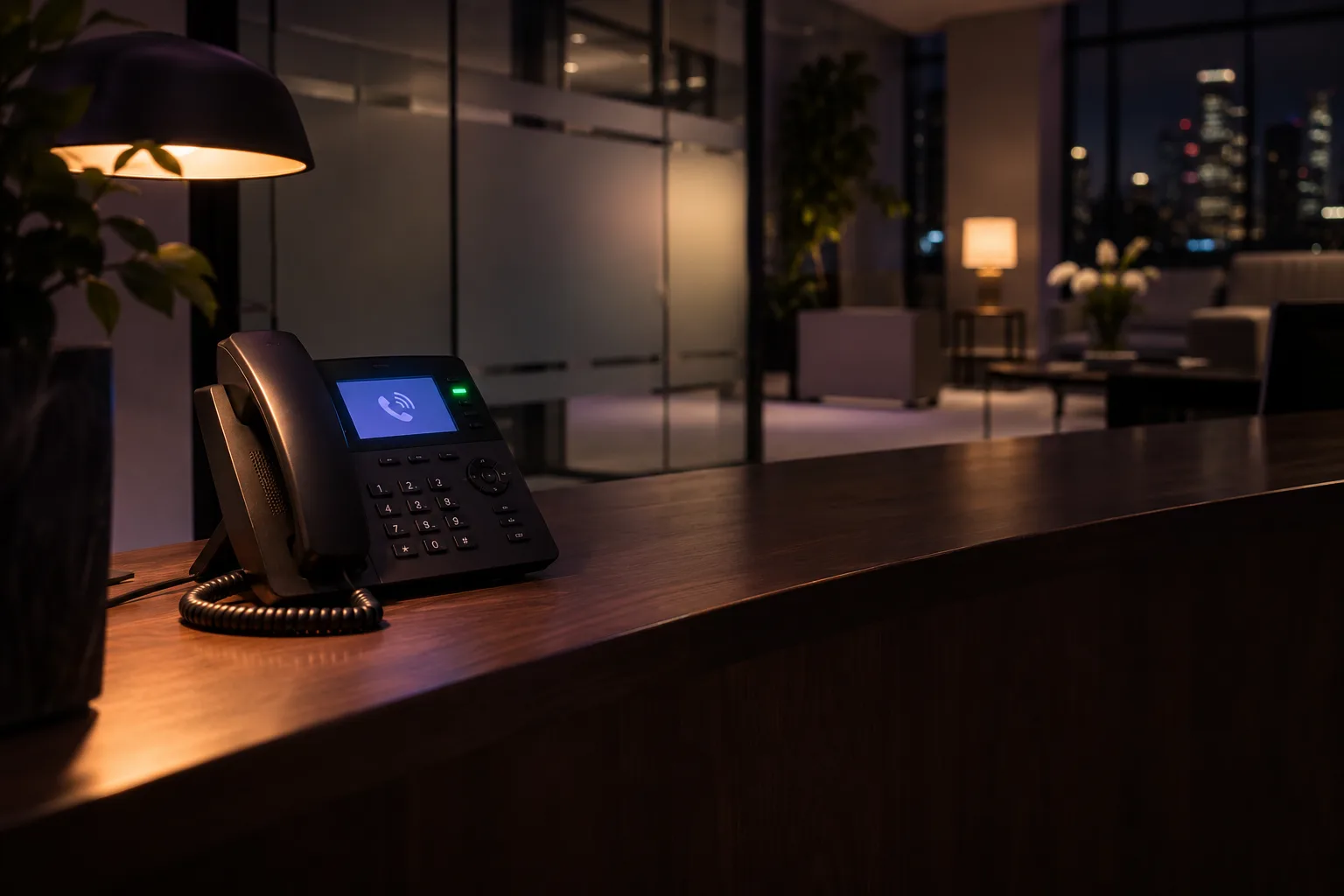
9:40 PM, Tuesday. A new client rings a law firm. Nobody is at the desk, the call goes to voicemail, and they hang up and try the next firm. The first firm never knows the call happened.
An AI receptionist is built to stop that. We built one for a law firm, Watson & Associates, and we run a similar agent on our own phone line. Here is what it actually does, section by section.
 What does an AI receptionist do?
It answers your business phone at any hour and handles the call from hello to booked. It greets callers by your business name, answers common questions from your own information, asks your intake questions, books the slot on your calendar and sends you a short summary. When a caller needs a person, it passes the call on.
The jobs, one line each:
- Answers every call: nights, weekends, lunch breaks, two lines ringing at once.
- Explains the basics: hours, location, services, what to bring.
- Qualifies the caller: what happened, what they need, how urgent, how to reach them.
- Books a real free slot on your calendar.
- Confirms by text or email, if you want that.
- Logs the details and a summary to your CRM or a spreadsheet.
- Hands over to a person when the call needs judgment or comfort.
Full list for our version: the receptionist agent page.
 What happens on a typical call?
The agent picks up, finds out why they called, asks your questions, then books a time while they are still on the line. A summary reaches you within moments. The whole call follows rules you approved, so it sounds like your best receptionist on a good day.
Four steps:
- Pick up on the first ring, using your business name.
- Listen for the reason: a new matter, a booking, a question.
- Ask the questions you wrote for that kind of call.
- Book one of two or three real times, then confirm it out loud.
A call to a law firm, close to how the Watson & Associates agent handles it:
Caller: Hi, I need to speak to someone about a contract dispute.
Agent: I can help set that up. What is the matter about, in a sentence?
Caller: A contract we had was terminated last week.
Agent: Thank you. I can't give legal advice, but I can book you a consultation with one of the attorneys. Does Thursday at 3 PM work?
What to notice:
- No opinions. It never comments on the dispute or guesses whether there is a case.
- Right facts first. It collects what a lawyer would ask in minute one.
- Ready summary. Name, number, type of matter, urgency and booked time land with the firm, so Thursday's call starts informed.
 What should an AI receptionist never do?
It should never give advice, hide that it is an AI, make promises you did not approve or sit on an emergency. Each limit is written into the agent's rules before it goes live and tested with deliberately awkward calls. These limits are what make it safe for law firms, clinics and accountants.
- No advice. It collects information and books. The lawyer, doctor or accountant answers the risky questions.
- Honest about being AI. Asked "Am I talking to a real person?", it says it is an AI.
- No surprise promises. No fees, outcomes or discounts unless you set those answers.
- Emergencies go to people. A clinic agent tells urgent callers to hang up and call 911. A firm can route an urgent caller to an on-call number.
- Recording follows your local rules. You approve the announcement wording.
If a vendor can't show you where these limits live in the setup, keep looking.
 How is it different from voicemail or an answering service?
Voicemail waits, an answering service takes a message, and an AI receptionist finishes the job in one call. It can answer the question, ask your intake questions and book the slot before the caller hangs up. That matters most for the caller who will never leave a message.
| Voicemail | Answering service | AI receptionist | |
|---|---|---|---|
| Picks up live | No | Yes | Yes |
| Knows your answers | No | A little | Yes, from your information |
| Books the slot | No | Rarely | Yes, on your calendar |
| Next morning you get | Missed calls | Messages to return | Booked appointments with summaries |
Plenty of callers hang up on voicemail and simply ring the next business. The agent turns that call into an appointment instead.
 Which businesses get the most from an AI receptionist?
Businesses where one missed call can mean one lost client: law firms, clinics, real estate agencies and accountants. They share three traits. Callers ring outside office hours, each new client is worth a lot, and the first questions are the same every time.
- Law firms: after-hours calls from people who need help now, after an accident or a contract falling apart. See AI for law firms.
- Clinics: booking and rescheduling calls all day while the front desk is busy with patients in the room.
- Real estate agencies: viewing requests in the evening and at weekends, when buyers actually browse.
- Accountants: a wave of calls around tax deadlines, mostly the same questions.
 How do you set up an AI receptionist that callers trust?
Write down how your best receptionist handles your five most common calls, turn that into rules, connect the phone and calendar, and test hard cases before any customer hears it. Then read the call logs every week for the first month. Testing is where most problems show up.
The setup in five steps:
- Write how your five most common calls should go.
- Turn that into questions, answers and limits, written as sentences.
- Connect your number, calendar and CRM.
- Test it yourself: angry callers, wrong numbers, people calling back.
- Review the call logs weekly and fix what you find.
What we learned on our own line. Our agent was built for outbound calls, so it always spoke first. On 3 November 2026 a lead called our number back, and the call dropped at once: the agent was waiting for an opening line only outbound calls had.
The fix, the same evening. On incoming calls it now waits for hello, looks the caller up by number and greets them by name.
A lead calling back is the warmest signal a business gets, and we nearly lost one. That's why we test incoming and outgoing calls separately.
Rules that matter most:
- Start narrow. Answering, intake and booking first. Add reminders later.
- Write limits as sentences. "Never quote fees. If asked, offer a call with a partner."
- Pick a model that follows rules. We use Claude for the thinking and ElevenLabs for the voice.
- Plan the hand-off. Who gets passed calls, at which hours, with what summary.
What to do next
Once calls are answered, the next win is speed on new leads: calling them back within minutes. That's our calling agent, which works alongside the receptionist.
To see how an AI receptionist would handle your own calls, the receptionist agent page shows how we learn your calls, write the rules, connect your number and test it with you before it goes live.
Questions people ask
Can callers tell they are talking to an AI receptionist?
Some can and some cannot, because modern voices sound natural. A well-built AI receptionist should say it is an AI whenever a caller asks, and never pretend otherwise. Most callers care more about getting a quick, clear answer and a booked slot than about who picked up.
Does an AI receptionist replace my front desk staff?
Usually not. It covers the calls your team cannot take: after hours, weekends, lunch breaks and the moments when two lines ring at once. Your staff still handle the visitors in the room, the delicate conversations and anything the agent hands over.
Can an AI receptionist book appointments on my calendar?
Yes. It connects to Google Calendar or your booking system, checks which slots are free, offers real times to the caller and books the one they choose. It can then send a confirmation by text or email and log the details to your CRM.
Can an AI receptionist give legal or medical advice?
It should not, and a good setup makes sure it cannot. The agent collects the facts, books the consultation and passes urgent cases to a person or an emergency line. Advice stays with the lawyer, doctor or accountant who is qualified to give it.